

















License Plates and Registration Numbers
from April 1960 to March 1968
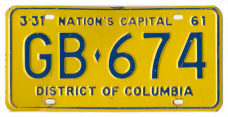 |
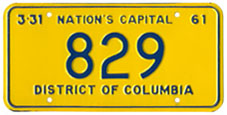
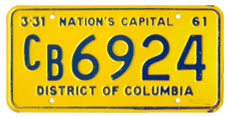
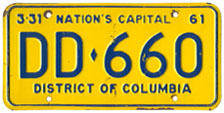
1960 April 1, 1960-March 31, 1961 |
 |
 |
 |
 |
|
 |
 |
|
 |
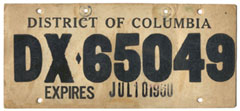
Detail-oriented observers will note that some 1960 plates have oblong holes whereas others have round holes. |
|
|
|||||||||||||||||||||||||||||||||||||||||||||
|
|
|
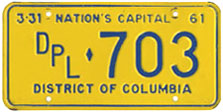
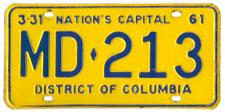
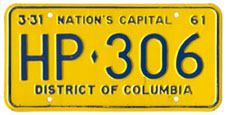
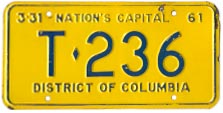
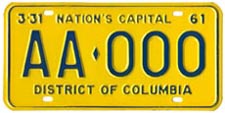
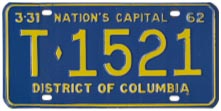
An overview of 1957-1963 registration numbers is provided on our page upon which plates of the 1950s are described. Click here to get there. Passenger - General-Issue. These 11 prefix letters have been observed on 1960 auto plates: A, E, G, J, K, M, N, P, R, S, and W. The highest observed number is WP-999. The number of registration number combinations from AA-100 through WP-999 is 209,700. Passenger - Reserved. Numbers 1 through 1250 were assigned by the Board of Commissioners. Non-Passenger. Refer to the 1957-64 registration numbers section referenced above for information about to which non-passenger types plates with prefix letters B, C, D, H, L, M, and T, as well as DPL, were assigned. |
 |
1961 April 1, 1961-March 31, 1962 |
 |
 |
|
 |
 |
|
 |
 |
|
 |
 |
|
 |
|
|
|||||||||||||||||||||||||||||||||||||||||||||
|
|
|
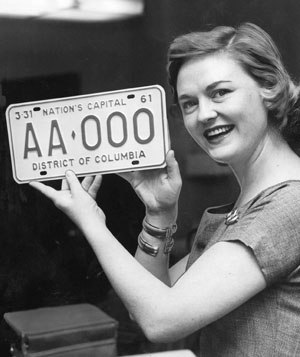
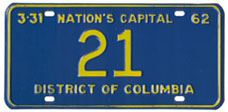
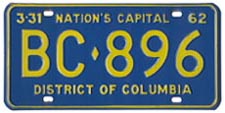
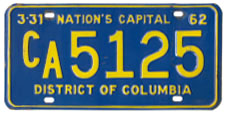
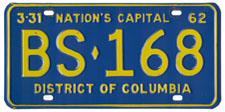
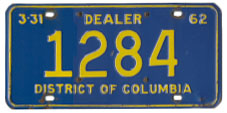
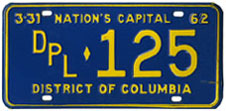
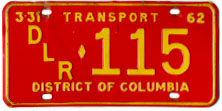
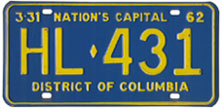
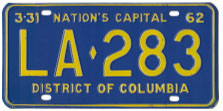
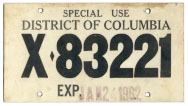
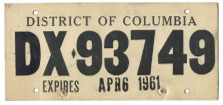
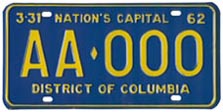
An overview of 1957-1963 registration numbers is provided on our page upon which plates of the 1950s are described. Click here to get there. Passenger - General-Issue. These 11 prefix letters have been observed on 1960 auto plates: A, E, G, J, K, M, N, P, R, S, and W. The highest observed number is WV-835. The number of registration number combinations from AA-100 through WV-835 is 214,036. Passenger - Reserved. Numbers 1 through 1250 were assigned by the Board of Commissioners. Non-Passenger. Refer to the 1957-64 registration numbers section referenced above for information about to which non-passenger types plates with prefix letters B, C, H, L, M, and T, as well as DPL, were assigned. This is the only year since 1948 for which dealer plates do not include a letter D prefix. |
 |
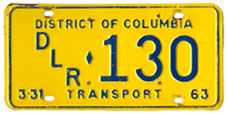
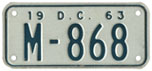
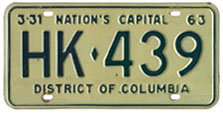
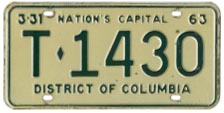
1962 April 1, 1962-March 31, 1963 |
 |
 |
|
 |
 |
|
 |
 |
 |
|
 |
 |
 |
|
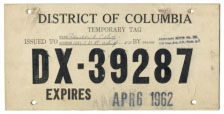
D.C. plates of 1962 were the first to be reflectorized. Click here to reach a page upon which this important change is discussed. |
|
|
|||||||||||||||||||||||||||||||||||||||||||||
|
|
|
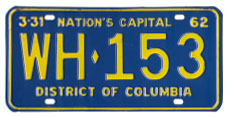
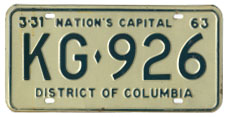
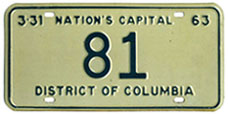
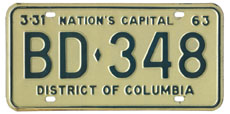
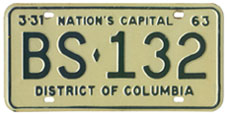
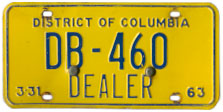
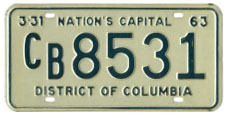
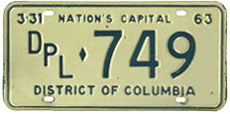
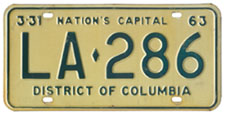
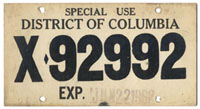
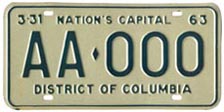
An overview of 1957-1963 registration numbers is provided on our page upon which plates of the 1950s are described. Click here to get there. Passenger - General-Issue. These 11 prefix letters have been observed on 1962 auto plates: A, E, G, J, K, M, N, P, R, S, and W. The highest observed number is WV-262. The number of registration number combinations from AA-100 through WV-262 is 213,463. Passenger - Reserved. Numbers 1 through 1250 were assigned by the Board of Commissioners. Non-Passenger. Refer to the 1957-64 registration numbers section referenced above for information about to which non-passenger types plates with prefix letters B, C, D, H, L, M, and T, as well as DPL, were assigned. |
 |
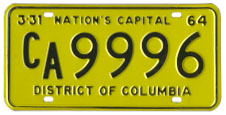
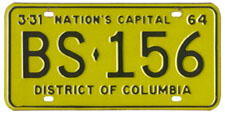
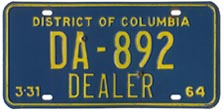
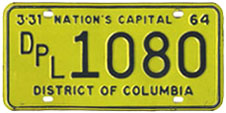
1963 April 1, 1963-March 31, 1964 |
 |
 |
|
 |
 |
 |
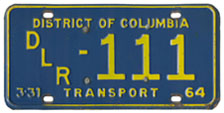 |
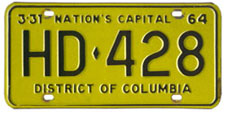 |
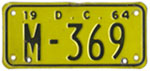 |
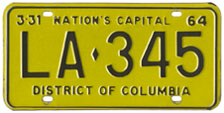 |
 |
 |
 |
|
|
|||||||||||||||||||||||||||||||||||||||||||||
|
|
|
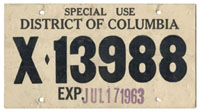
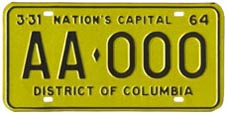
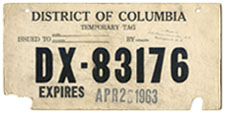
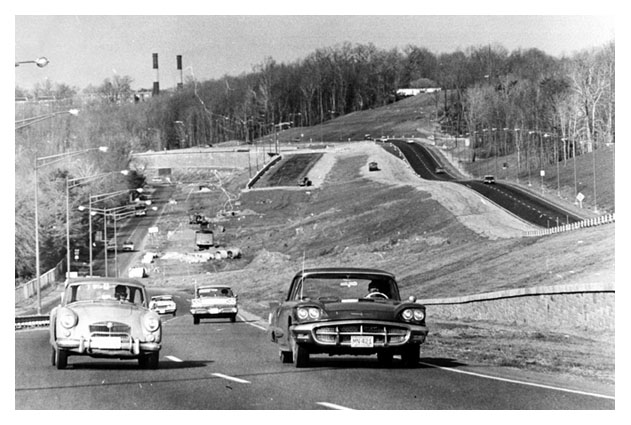
An overview of 1957-1963 registration numbers is provided on our page upon which plates of the 1950s are described. Click here to get there. Passenger - General-Issue. These 12 prefix letters have been observed on 1963 auto plates: A, E, G, J, K, M, N, P, R, S, W, and X. The highest observed number is XJ-763. The number of registration number combinations from AA-100 through XJ-763 is 224,764. Passenger - Reserved. Numbers 1 through 1250 were assigned by the Board of Commissioners. Non-Passenger. Refer to the 1957-64 registration numbers section referenced above for information about to which non-passenger types plates with prefix letters B, C, D, H, L, M, and T, as well as DPL, were assigned. |
 |
 |
 |
 |
 |
 |
|
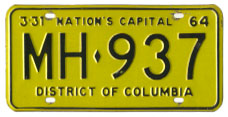
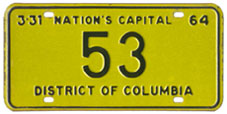
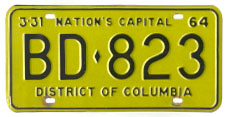
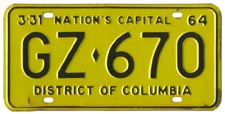
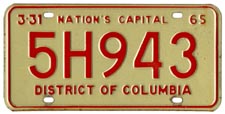
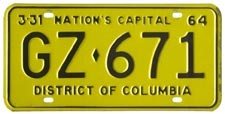
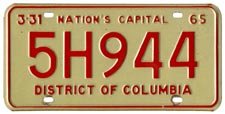
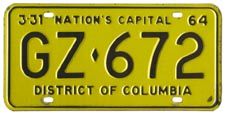
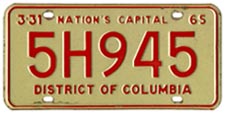
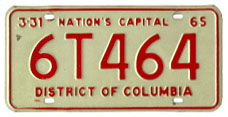
It is unusual to locate two used license plates with consecutive registration numbers, and to have three in a row is very rare. These sets of sequentially-numbered passenger car plates illustrate the predictable manner in which numbers were assigned during the 1963 and 1964 registration years.
|
|
 |
1964 April 1, 1964-March 31, 1965 |
 |
 |
|
 |
 |
 |
 |
 |
 |
 |
 |
 |
 |
|
|
|||||||||||||||||||||||||||||||||||||||||||||
|
|
|
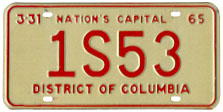
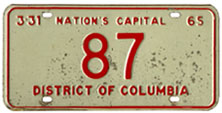
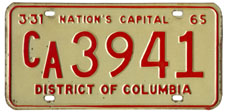
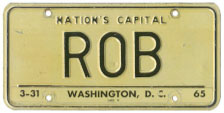
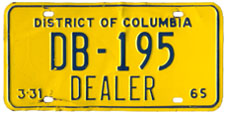
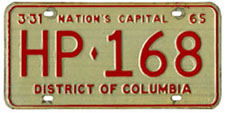
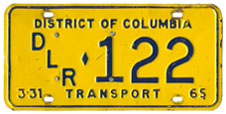
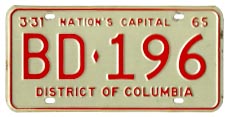
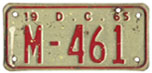
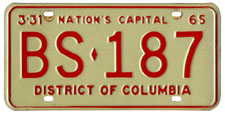
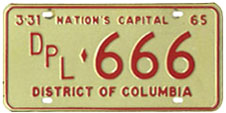
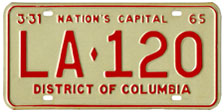
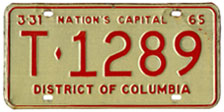
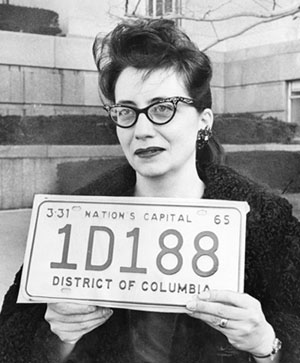
Passenger - General-Issue. The passenger registration format was completely changed for 1964. The chosen configuration is curious for a number of reasons, primarily because it did not provide enough combinations whereas the previous format (AB-123) would have if the X, Y, and Z series had been fully utilized. The first and most common format of 1964 auto plates is comprised of one number followed by a single letter and three numbers. In effect, therefore, the first-position letter of 1957-63, of which 12 were used (and 14 were available), was replaced by a number, of which there are only nine. Furthermore, whereas on earlier plates all three-digit numbers 100 through 999 were used, on 1964 plates no triple-repeating numbers (111, 222, 333, etc.) appear after the letter, further limiting the number of available registration combinations. Numbers in this first format therefore began at 1A101 and ended at 9Z998. All letters except F, I, O, and Q were used. This series of plates provides for 184,230 combinations, all of which were assigned. Because the first series of numbers was depleted, four-digit registrations in a similar format were issued starting at 1A11 and ending at 9Z99. This series provides for 18,423 combinations. Whether all were issued is unknown, but if they were, which is certainly a possibility, a third format would have had to be introduced. The highest observed number is 2T56. Passenger - Reserved. Numbers 1 through 1250 were assigned by the Board of Commissioners. Non-Passenger. Despite the overhaul of general-issue passenger registration numbers, non-passenger numbering remained unchanged from 1957-63. Numbers on plates of most types begin with a letter, and several types are numbered in the 1957-63 passenger format but with certain letters followed by a serial letter (although F, I, O, and Q continued to not be used in the serial (i.e. second) letter position). For example, 1964 Bus plates are numbered beginning at BA-100. Distinctive plates for rental cars returned for 1964 after a nine-year hiatus, as discussed here. Notable exceptions to the two-letter, three-number format are Commercial, Motorcycle and Diplomatic, plates of which began at CA-1000, M-1 and DPL-1, respectively. Specifically, here are the nine known non-passenger 1964 types and the first assigned number of each: Bus, BA-100; Commercial (Truck), CA-1000; Dealer, DA-100; Diplomatic, DPL-1; Hire (Taxi), HA-100; Livery, LA-100; Motorcycle, M-1; Rental Car, RA-100; and Trailer, T-100. |
 |
1965 April 1, 1965-March 31, 1966 |
 |
 |
|
 |
 |
|
 |
 |
 |
|
 |
 |
|
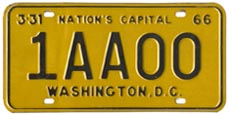 |
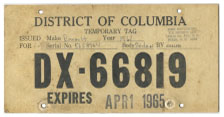
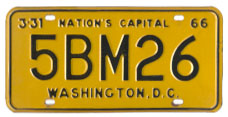
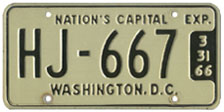
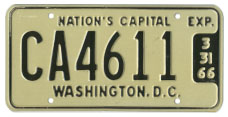
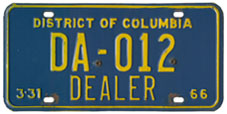
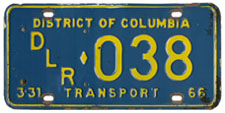
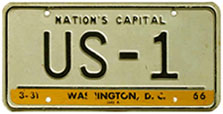
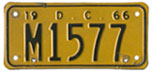
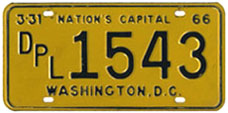
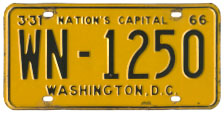
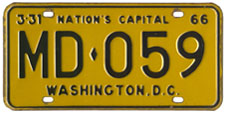
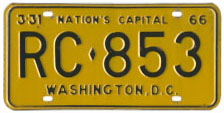
New narrower dies and a new black-on-white color scheme began to be introduced for 1965, making this a confusing year for Washington, D.C. license plates. This is also the first year that the city name is displayed as WASHINGTON, D.C., although it would not be until 1969 that this change was reflected on Dealer and Transport plates. For further information about the confusing 1965 and later plates, click here. |
|
|
|||||||||||||||||||||||||||||||||||||||||||||
|
|
|
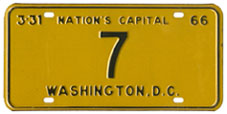
Passenger - General-Issue. Because the number of available configurations in the configuration introduced for 1964 was insufficient, another new format was utilized for 1965: one number, two letters, then two numbers. This is actually a variant of that used from 1957 through 1963, being comprised of two letters and three numbers although in a different, more confusing order than in the past. The advantage of this format is that the first of the two letters can duplicate first-position letters of non-passenger plates such as B, H, and L, allowing for more passenger combinations. For example, 1BA23 can be issued as a passenger number while BA-123 is still used for a bus registration. Numbers in the 1965 format began at 1AA01 and proceeded as high as necessary. The letters F, I, O, and Q are not used in either letter position. Unlike 1964 triple-repeating numbers are known to have been used for 1965 because plate number 2BB22 has been observed. Regarding the order of registration number assignment, all numbers, including the one to the left of the letters, changed before letters. For example, the C series began at 1CA01 and numbers were assigned through 1CA99, then 2CA00 through 2CA99, all the way through 9CA99. Only then would a letter be changed. The CB series would then be assigned beginning at 1CB01. The highest observed number is 2MH31, which is the 232,779th general-issue number assigned during the 1965 registration year. Passenger - Reserved. Numbers 1 through 1250 were assigned by the Board of Commissioners. Non-Passenger. Despite the overhaul of general-issue passenger registration numbers, non-passenger numbering remained unchanged from 1957-64. Numbers on plates of most types begin with a letter, and several types are numbered in the 1957-63 passenger format but with certain letters followed by a serial letter (although F, I, O, and Q continued to not be used in the serial (i.e. second) position). For example, 1965 Bus plates are numbered beginning at BA-001. Notable exceptions to the two-letter, three-number format are Commercial, Motorcycle and Diplomatic, plates of which began at CA-1000, M-1 and DPL-1, respectively. Specifically, here are the ten known non-passenger 1965 types and the assumed first assigned number of each: Bus, BA-001; Commercial (Truck), CA-1000; Dealer, DA-001; Diplomatic, DPL-1; Hire (Taxi), HA-001; Livery, LA-001; Motorcycle, M-1; Rental Car, RA-001; Trailer, T-001; and Diplomatic Staff, WN-1000. |
 |
1966, '67 April 1, 1966-March 31, 1968 |
 |
 |
|
 |
 |
|
 |
 |
|
 |
 |
|
 |
 |
|
 |
|
|
||||||||||||||||||||||||||||||||||||||||||||||||||||||
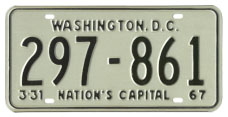
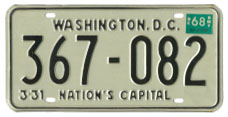
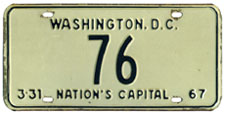
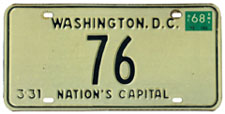
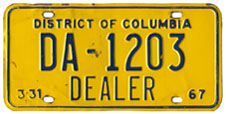
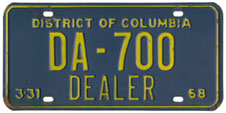
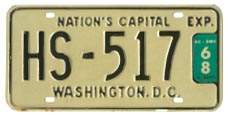
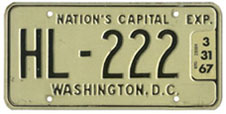
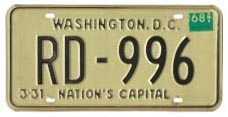
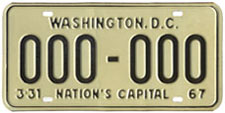
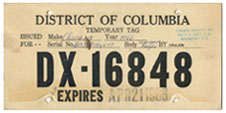
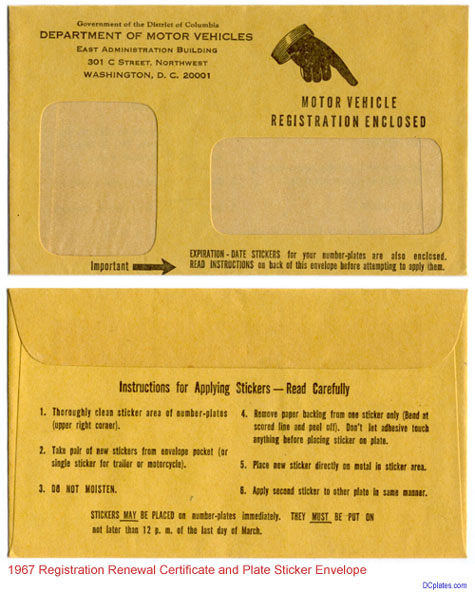
Washington, D.C. license plates of the 1966-68 and 1968-74 baseplates are often confused for two reasons, the first of which is their similar appearance. Because they share a color scheme, only the reversed positions of the city name and slogan and the blocks of numbers that appear on auto plates may be used to tell them apart. Second, with the introduction of this base in early 1966 plates of certain non-passenger types were not replaced, contrary to the past practice of always replacing passenger and non-passenger plates simultaneously. This overlapping of three bases (1965, 1966-68, and 1968-74, as discussed in the Non-Passenger Numbering section below) continues to confuse collectors today. There are two distinct varieties of this two-year baseplate: dated and undated. Both styles have "3-31" embossed in the lower left corner. The dated version has "67" stamped in the lower right corner whereas the undated variety does not. As with plates of earlier years, dated plates were used for the 1966-67 registration year with no other visible form of validation (i.e. a plate or window sticker), and for the 1967-68 registration year they were validated with white-on-green dated “68” stickers placed in the upper right corner. Nineteen sixty-six baseplates were replaced during March 1968 for the registration year that began on April 1, 1968.
License plate collectors should note that mint (unissued and unused) examples of both styles of the 1966 base are relatively plentiful. |
|
|
|
After several years of experimenting with various general-issue numbering formats, officials of the D.C. DMV returned to the one that had served well for many previous years: six-digit numbers assigned sequentially as high as necessary. Registration numbers for non-passenger vehicles continued to feature letter prefixes to denote the type. Passenger - General-Issue. A block of 300,000 six-digit registration numbers, 100-001 through 400-000, was set aside for this base. Not all were issued, however, and the ample supply of unissued plates makes these two years among the easiest for collectors to locate. The cutoff point between dated and undated varieties of this base is unknown. For years it has been assumed to be numbers 300-000 (last dated) and 300-001 (first undated). However, assuming that, as in previous years, slightly more than 200,000 registration numbers would be required for the 1966 registration year and that DMV officials were aware of this as the plates were being manufactured during 1965, and taking into consideration that we have not observed any examples of this base numbered between dated plate no. 299-992 and undated plate no. 320-064, we are left to wonder whether 1966 baseplates may have been dated into the 300-000 series, perhaps up to 320-000. Only by observing examples numbered between 300-001 and 320-000 will be able to estimate when the "67" year designation was removed from the lower right corner to effectively create the undated variety. Undated plates could not have been issued during the 1966 registration year because the "67" year designation would be absent. However, dated plates leftover from 1966 could have been issued during the 1967 registration year because the year designation would appear in the form of the "68" sticker, making these plates appear identical to plates issued in 1966 and renewed for 1967.
We know that in the late 1960s or early 1970s the DMV sold surplus, unissued plates at auction, some of which were purchased by collectors. Perhaps 6 lots of 500 pairs each, comprising the range of 297-001 through 299-999, were sold, but only two of the lots were purchased by plate collectors, thus the lack of used or unused plates from 297-001 through 297-500 and 298-001 through 299-500. This is just a guess, and we don't know why these apparently large blocks of plates were unissued. It would be easy to assume that numbers above about 295-000 simply were not needed during the 1966 registration year except that given plate quantities that appear to have been issued in 1965 and earlier years (based upon registration numbers of known used plates), it doesn't seem reasonable that only 195,000 sets of plates would have been be needed from April 1966 through March 1967.
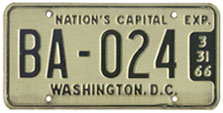
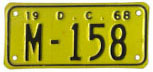
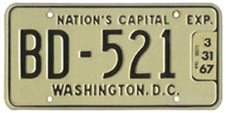
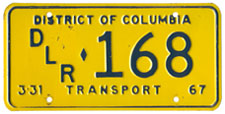
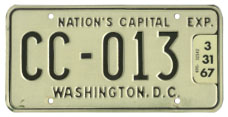
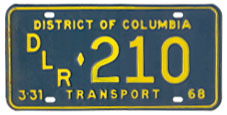
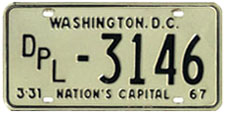
Also held by collectors are unused undated plates from outside of the 366-501 through 367-500 range, such as 322-822, 335-452, and 351-393. However, the lack of more than one or two with close numbers suggests that these are isolated unissued plates, not part of a larger span of plates not used. Passenger - Reserved. Numbers 1 through 1250 were assigned by the Board of Commissioners. The black-on-white color scheme and new, narrow dies of 1966 baseplates were actually introduced one year earlier on Commercial plates of 1965 (and marked EXP. 3-31-66 as shown above). These 1965 Commercial plates were revalidated with stickers for several years, and right through the two-year life of the 1966 baseplate, so that there is no Commercial plate on this base. Plates of some types (such as Bus and Livery) were replaced with new black-on-white plates for 1966 that were used beyond the useful life of auto plates of this base, whereas other non-passenger plates (we believe that Rental Car, Medical Doctor and Diplomatic are examples) were replaced in 1966 and 1968 on the same schedule as auto plates. In short, the period of April 1965 through March 1974 is a confusing one when it comes to identifying when non-passenger plates were issued and replaced. Compounding the problem is that many examples of these plates held by collectors today are unused and thus do not include validation stickers that would provide information as to their period of use. For further information, visit our page dedicated to this period by clicking here. |
|
This page last updated on December 31, 2017 |
 |
|
copyright 2006-2018 Eastern Seaboard Press Information and images on this Web site may not be copied or reproduced in any manner without consent of the owner. For information, send an e-mail to admin@DCplates.net |
