


Washington, D.C. Dealer License Plates
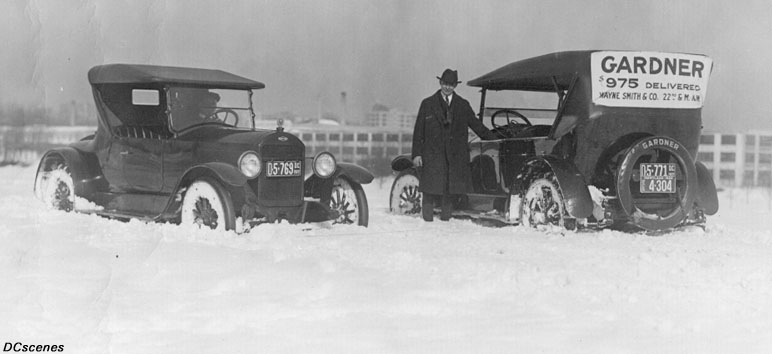
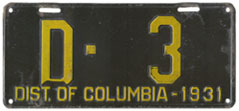
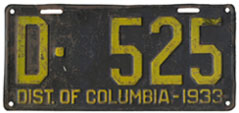
As in most U.S. jurisdictions, one of the oldest registrations types in the District of Columbia is that issued especially for use by motor vehicle dealers. Distinctive license plates, with a letter D prefix, were first issued for dealers in 1919. One might expect the type to have been introduced a year earlier, when annual, dated plates for passenger cars and motorcycles made their debut. However, when plans for the 1918 plates were being made during 1917, as the porcelain era drew to a close, officials realized that they no idea how many valid registrations were in use by dealers. In fact, they also had absolutely no idea of the quantity of private passenger and motorcycle registrations, because 1903-17 registrations were permanent, with no renewal (annual or otherwise) required. This problem, which was largely responsible for the retirement of the District's permanent 1907-17 porcelain enamel plates, made it impossible to estimate how many plates to have made. Officials had no choice but to have 1918 auto plates made (and it turns out that they underestimated the number required and had to have more made during the year), but they had the option of not issuing distinctive plates for dealers. They apparently kept track of how many auto plates were issued for use by dealers so that for 1919 they were able to order a reasonable number of D-prefix markers.
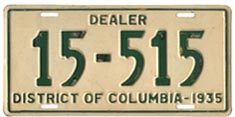
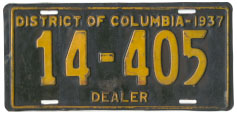
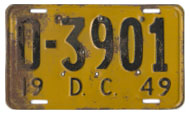 |
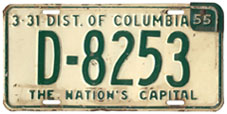 |
 |
1949 |
1954 |
1956 |
 |
 |
1958 |
1960 |
 |
 |
 |
1961 |
1962 |
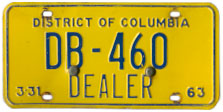
1963 |
 |
 |
 |
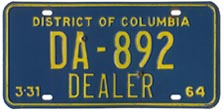
1964 |
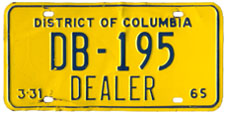
1965 |
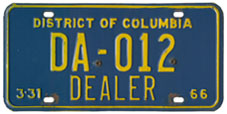
1966 |
 |
 |
 |
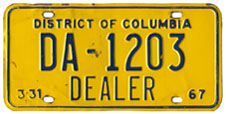
1967 |
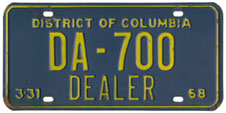
1968 |
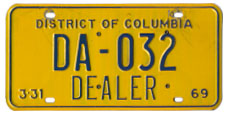
1969 |
 |
 |
 |
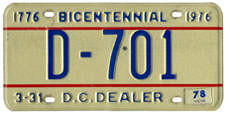
1974 Baseplate |
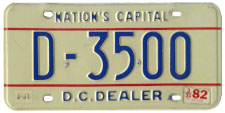
1978 Baseplate |
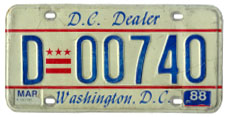
1984 Baseplate |
 |
 |
2003 - embossed style |
2003 - flat style |
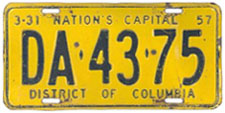
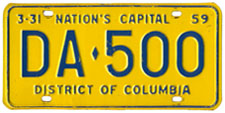
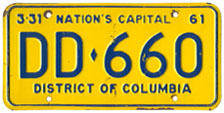
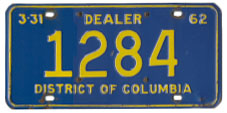
Washington, D.C. dealer plates have almost always featured a letter D prefix. From 1948 through the 1960 registration year (i.e. the plate marked 3-31-61), the presence of a D as opposed to any other letter in the prefix position was the only feature that distinguished dealer plates from plates of other types. This apparently led to difficulties in enforcing regulations to the effect that vehicles upon which these plates were displayed could be used only for demonstration purposes, and not for general transportation, causing the Commissioners in April 1960 to change the plate format (effective with 1961 plates) to include the type name, DEALER, and an all-numeric registration. Numbers began at 1000, and the type name was embossed in small letters at the top. The highest observed number is 3514. The official justification for this change is as follows: "It is felt that by spelling out the word DEALER, these tags will be more conspicuous and will lead to better enforcement of their proper use than the present method of using a prefix such as DA, DB, DC, etc."
For 1962 the type name was made more prominent and the numbering configuration was changed back to that of 1957-60: a two-letter prefix comprised of a D followed by a serial letter. Whether numbers in each letter series began at 001 (e.g. DA-001) or 100 for 1962, 1963, and 1964 is unknown, but for 1965 numbers as low as DA-003 and DA-006 are known.
The numbering format was changed again for 1966. Rather than assign number DB-001 after DA-999, numbers continued at DA-1000, DA-1001, etc., so that all 1966 dealer plates have a DA prefix. The highest observed number is DA-2168, which would have been no. DC-170 under the 1965 numbering system. This format continued to be used into the early 1970s, probably until the 1974 base, the first true multi-year baseplate for dealers, was introduced in April of that year.
With the exception of 1945, when all D.C. plates were issued singly, from 1919 until 1961 dealer plates were issued in pairs. Since 1962, however, only one plate has been issued for each registration. The change was made due to repeated instances of unscrupulous dealers using the two plates of a pair on different vehicles, thereby evading the payment of registration fees.
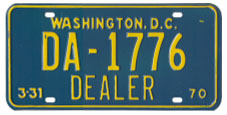
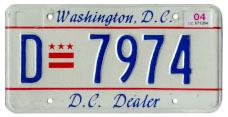
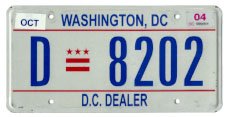
The city name was changed from DISTRICT OF COLUMBIA to WASHINGTON, D.C. on the 1969 (exp. 3-31-70) plate, four years after the change was made on plates of most other types (including passenger). From 1974 through 2004, dealer plates shared characteristics and periods of use with plates of other types.
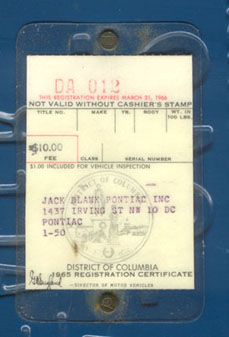
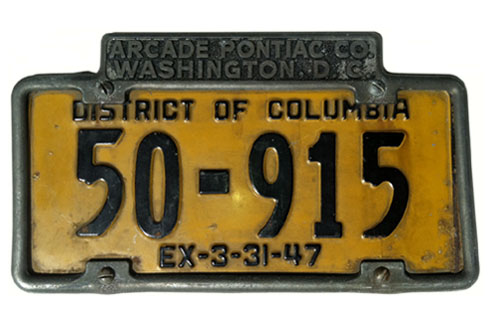
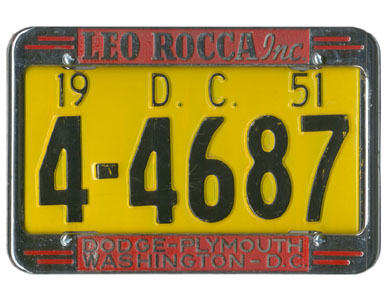
An interesting plate-related custom in Washington, D.C. is that vehicle dealers routinely affix their registration certificate to the back of their plate. Today this is often accomplished with tape, but for many years the registration was laminated or sewn into a plastic sleeve that was then riveted to the plate. That's why you can see rivet heads (or extra holes where rivets were removed) on several of the plates pictured above.
 |
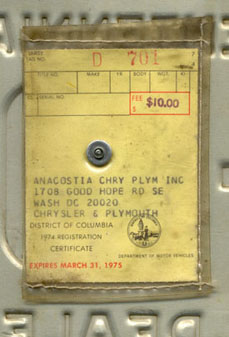 |
| Most Washington, D.C. dealer plates from the late 1940s through the 1970s have the corresponding registration certificate riveted to the back in some sort of watertight (hopefully) holder. These 1965 (left) and 1974 certificates are attached to plates DA-012 and D-701 pictured above, respectfully, although the latter is the first registration issued with that plate, which is to say that it wasn't replaced by later certificates as the registration was revalidated annually. Note that the each registration includes a notation as to which vehicle make(s) the dealer represented (even if it was not indicated in the agency's name). The "1-50" notation on the 1965 certificate may indicate the span of registration numbers issued to this dealer, i.e. DA-001 through DA-050. |
Dealer Plates Since 2004
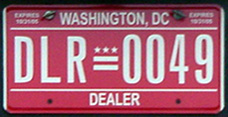
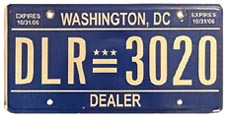
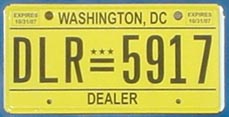
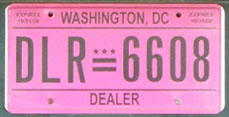
The multi-year dealer plate era ended on Oct. 31, 2004, when the use of annual plates began. Since then, the background color has been changed annually in order to make these limited-use plates more visible. As for their numbering, registrations began at DLR-0000 or DLR-0001 in 2004 and progressed through or close to DLR-9999 on the 2011-12 plate, at which time a new five-digit format began at DLR0000 (or possibly DLR00001). Characteristics of 2004 and more recent dealer plates are as follows:
Observed Numbers |
||||
Year |
Colors |
Period of Use |
Lowest |
Highest |
2004 |
white on red |
Nov. 2004-Oct. 2005 |
DLR-0049 |
|
2005 |
white on blue |
Nov. 2005-Oct. 2006 |
DLR-3020 |
DLR-3963 |
2006 |
black on yellow |
Nov. 2006-Oct. 2007 |
DLR-5917 |
DLR-5924 |
2007 |
black on pink |
Nov. 2007-Oct. 2008 |
DLR-6443 |
DLR-7065 |
2008 |
black on green |
Nov. 2008-Oct. 2009 |
DLR-7183 |
DLR-7820 |
2009 |
white on blue |
Nov. 2009-Oct. 2010 |
DLR-8041 |
DLR-8400 |
2010 |
black on yellow |
Nov. 2010-Oct. 2011 |
DLR-8882 |
DLR-9071 |
2011 |
white on green |
Nov. 2011-Oct. 2012 |
DLR-9389 |
DLR-9610 |
2012 |
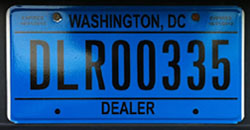
black on blue |
Nov. 2012-Oct. 2013 |
DLR00188 |
DLR00335 |
2013 |
black on maroon |
Nov. 2013-Oct. 2014 |
DLR00950 |
|
2014 |
black on yellow |
Nov. 2014-Oct. 2015 |
DLR01083 |
DLR01392 |
2015 |
black on grey |
Nov. 2015-Oct. 2016 |
DLR01676 |
DLR01822 |
2016 |
black on green |
Nov. 2016-Oct. 2017 |
DLR02001 |
|
2017 |
black on red |
Nov. 2017-Oct. 2018 |
||
 |
 |
Nov. 2004-Oct. 2005 |
Nov. 2005-Oct. 2006 |
 |
 |
Nov. 2006-Oct. 2007 |
Nov. 2007-Oct. 2008 |
 |
 |
|
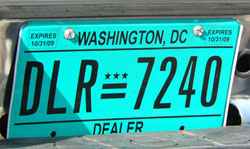 |
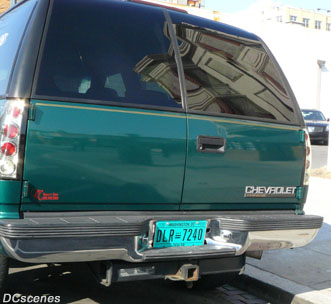
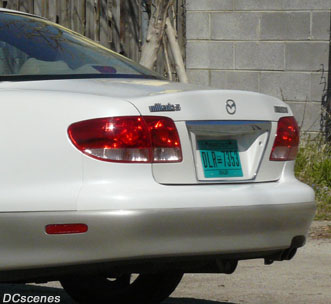
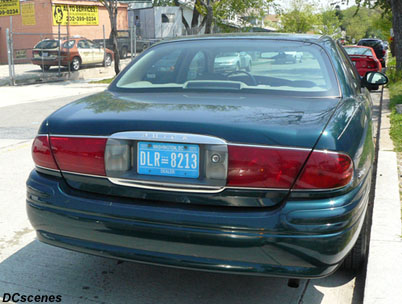
Nov. 2008-Oct. 2009 Our best representation of the true color of the 2008-09 dealer plate is shown in these images of no. 7240, pictured in direct sunlight. No. 7353 (above right) shows how much darker the plate looks when not in the sun. Dealer registration numbers continue to be assigned sequentially, regardless of the annual plate upon which they are displayed, as shown in numbers on the 2004-05 and later plates pictured above. |
 |
 |
|
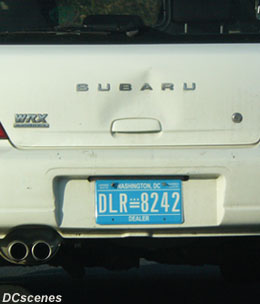
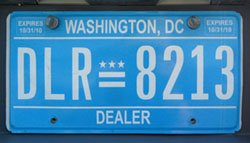
Nov. 2009-Oct. 2010 The 2009-10 dealer plate is as difficult to photograph as the 2008-09 issue, perhaps more so because the two colors are similar and relatively light. DMV officials appear to have chosen for this plate the same color scheme as the 2005-06 dealer plate. |
|
|
 |
|
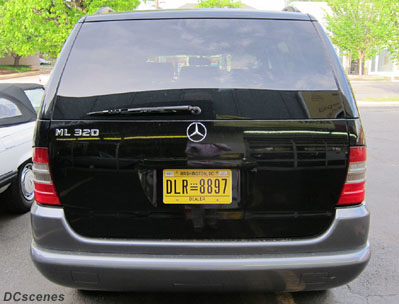
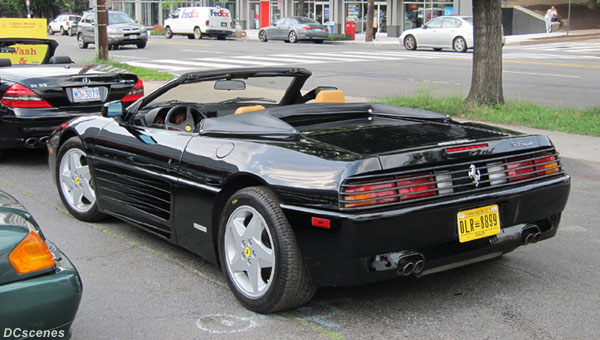
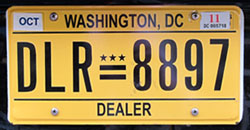
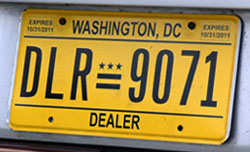
Nov. 2010-Oct. 2011 Examples of the bright yellow 2010-11 dealer plate have been observed both with and without validation stickers. Why some plates have stickers even though the expiration date is printed in the upper corners is unknown. Perhaps the date was printed incorrectly on earlier plates of the series. |
||
 |
||
 |
|
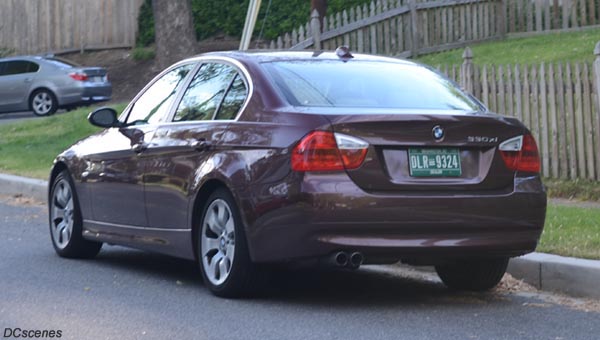
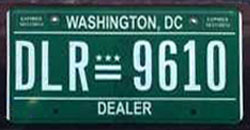
Nov. 2011-Oct. 2012 The white-on-dark-green 2011-12 dealer plate was the last of eight consecutive annual plates to feature this numbering format with the D.C. flag divider introduced in late 2004. |
 |
 |
||
|
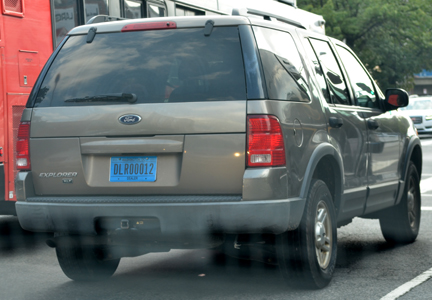
Nov. 2012-Oct. 2013 A new five-digit numbering configuration was introduced for 2012, presumably at number DLR00000 or DLR00001. If numbers are assigned sequentially year after year all the way to 99999, when one considers that it took eight years to assign the 10,000 registration numbers afforded by the previous four-digit format it could be estimated that this new format may last many decades. |
|
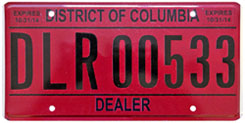
Nov. 2013-Oct. 2014 The 2013-14 dealer plate is black on maroon. Despite the change to a five-digit serial with the 2012-13 plate, based solely upon 2013-14 plates observed in use it appears that their numbers did not begin where those of the 2013-13 plate ended, but rather began again at DLR00000 or DLR00001. |
 |
|
|
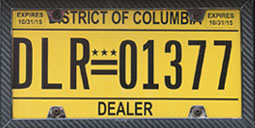
Nov. 2014-Oct. 2015 The 2014-15 dealer plate is black on yellow. Although these plates retain the eight-character format used for the previous two years, for 2014 the D.C. flag divider has returned to its position between the DLR prefix and serial number. |
|
 |
||
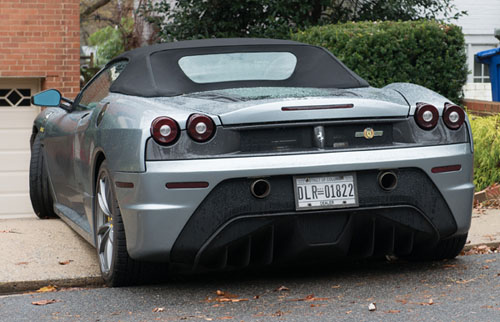
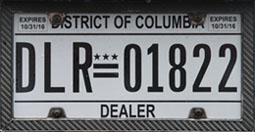
Nov. 2015-Oct. 2016 The 2015-16 dealer plate is black on grey. Its format is consistent with the 2014 plate, and 2015 numbers began at or about where 2014 numbers ended. |
 |
|
|
Nov. 2016-Oct. 2017 The 2016-17 dealer plate is black on green. Its format is consistent with the 2015 plate, and 2016 numbers began at or about where 2015 numbers ended. |
|
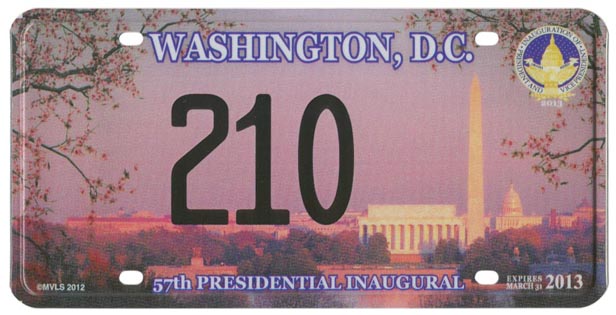
Nov. 2017-Oct. 2018 The 2017-18 dealer plate is black on red, and numbering has reverted to the 2004 to 2011 format, e.g. DLR-1234. |
 |
|

|
This page last updated on December 31, 2017 |
 |
|
copyright 2006-2018 Eastern Seaboard Press Information and images on this Web site may not be copied or reproduced in any manner without consent of the owner. For information, send an e-mail to admin@DCplates.net |
